The downy woodpecker is an important predator of Eurosta
larvae in some areas. In winter, when the woodpecker's other food becomes
scarce, the downy turns to feeding on the larvae overwintering within ball galls.
At some sites in central Pennsylvania predation rates sometimes exceed 60%.
Research has shown that the woodpecker preferentially chooses larger galls to
feed from. This produces a strong selection for small gall size at sites
where woodpecker predation is heavy. Since, another predator of the Eurosta
larva, the parasitoid wasp Eurytoma gigantea,
selects galls with small diameter, the selection from the woodpecker and Eurytoma
together can create a net selection for
intermediate sized galls. Many researchers have suggested that downy
woodpeckers tap on galls to locate the fly's emergence tunnel (which the fly
excavates prior to going into diapause in the Fall). Field experiments
have shown that downy woodpeckers use the presence of an emergence tunnel to
determine whether a gall might contain an Eurosta larva. Other
researchers have found that when birds attacked galls containing E.
obtusiventris, they did not eat the wasp larva, even though it was exposed.
The authors suggest that the wasp may be distasteful due to the presence of
plant resin.
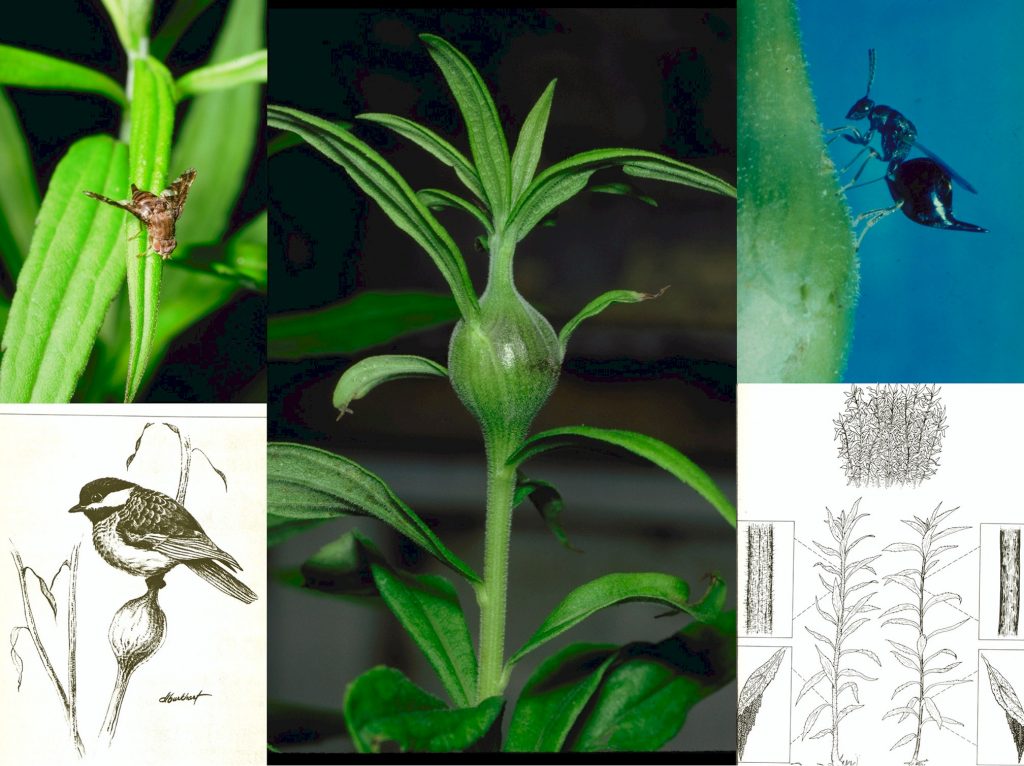
The
Black-capped Chickadee is another common avian predator of Eurosta larvae.
At some sites in southern Ontario, chickadees attack up to 50% of galls. Since
chickadee's lack the powerful chisel-like beak of woodpeckers, they make large
rough holes in the sides of galls by grabbing bits of the gall and pulling them
apart.
|
|
|
|
|
|
| Solidago and Eurosta Links |
|
|