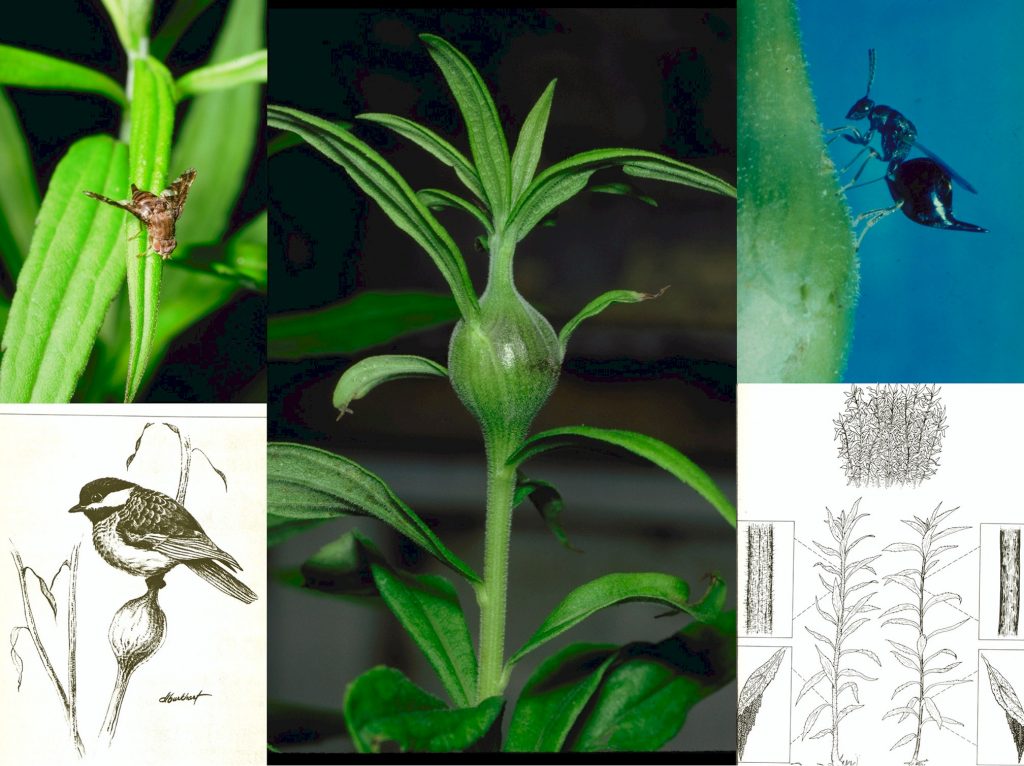
The goldenrod, gall fly, and natural
enemies system has been used to study important concepts in ecology and evolution.
Three of the topics which we have studied, using this system, are host-race
formation, tri-trophic interactions, and selection
in nature (illustrated by gall-size selection).
Host-race formation is the formation of
specialized populations of organisms which use different hosts. In our
system, the host races are populations of gall flies which produce galls on
different species of goldenrods. Host-race formation is considered to
be important because it represents a step along a path to sympatric speciation.
Most often, speciation is thought to occur allopatrically, which means that
the individual populations which evolve into new species are geographically
isolated (separated in space). Sympatric speciation is the evolution of
new species from populations that are not geographically isolated. This
would seem to be impossible since biologists agree that for speciation to occur
there must reproductively isolated populations within a species. If this
were not true, then the species would be made-up of one interbreeding population
and no genetic differentiation could occur. The most obvious form of reproductive
isolation is geographic isolation. What better way to keep populations
from interbreeding, then to keep them separated? However, what if populations
could be reproductively isolated is some other manner? In our system,
the host races of gall flies mate, lay eggs, and their larva develop on different
species of goldenrod. This host-plant preference is very strong.
Because the gall flies nearly always mate on their own host goldenrod, each
host race of flies is reproductively isolated from those that use other species
of goldenrod. This allows the host races to be reproductively isolated,
even though they occur in the same fields. If the host races of flies
continue to be isolated for long enough they could potentially evolve into separate
species. This would be an example of sympatric speciation.
Another area
of research in our lab has been on the selection of gall size. First we
need to define some terms. The first is natural selection. Organisms
that are better adapted to their environment are able to produce more offspring
which causes their genes to become more common in the population. Natural
selection requires that there be some variability among individuals in the population,
otherwise no differentiation would occur. This variability is generated
through recombinations and mutations, which are changes in the genetic constitution
of an individual. Another important term is fitness. A species'
fitness can be defined as its ability to pass its genes on to the next generation.
Many factors can affect a species fitness and these factors may vary from species
to species. Individuals that are favored by natural selection are said to have
a high fitness.
In the ball gall system one good measure of gall fly
fitness is probability that a larva will survive (survivorship). In some
cases this is greatly influenced by the size of the gall that a larva induces
in the plant. But what size gall is the best? As it turns out, this
depends on several different factors. In places where the Eurytoma
gigantea wasp (a very effective predator of gall fly larvae) is abundant,
there is strong selection for large galls. This is because large galls
have walls that are too thick for the wasp's ovipositor to penetrate, protecting
the gall fly larva. In this case, flies that produce large galls may have
high fitness, while those that produce small galls may have low fitness.
In areas where downy woodpeckers are abundant the story is different. Downy
woodpeckers are also very efficient predators of the gall fly larvae and
preferentially choose large galls over small galls. It's assumed that
they choose large galls because those galls are likely to contain larger larva,
making a better meal for the effort. So, in areas with lots of downy woodpeckers,
flies that produce large galls may have low fitness and flies which produce
small galls may have high fitness.
Finally, in the case where both Eurytoma gigantea
wasps and downy woodpeckers are common the two competing selection pressures
produce a net selection for intermediate (medium) sized galls. Other factors
that have been shown to affect gall size are the ability of the flies to produce
large or small galls and the effect of the plant on gall size. In fact,
if you look carefully in many goldenrod fields you will see that the galls on
each goldenrod clone are nearly the same
size. While one clone contains all large galls, another will have all
small galls, still others will have galls of intermediate size. Researchers
in our lab have found that while gall size is heritable in Eurosta, the
heritability of gall size in the goldenrod is the strongest controller of gall
size. To put it another way, although gall flies do have some influence
over gall size and this influence is passed down from parent flies to their
offspring, the genetically-determined influence of gall size by the plant is
a greater factor in determining gall size.
|
|
|
|
|
|
|
|
|
|