Goldenrods
are one of eastern North America's most common wildflowers. In much of
the northeastern United States, old fields are converted to fields of gold when
the goldenrod blooms in late summer. While there are around 130 species
of goldenrod in two genera, our laboratory works primarily with only three species
in the genus Solidago: Solidago canadensis, Solidago gigantea,
and Solidago altissima. Much of the lab's recent work has revolved
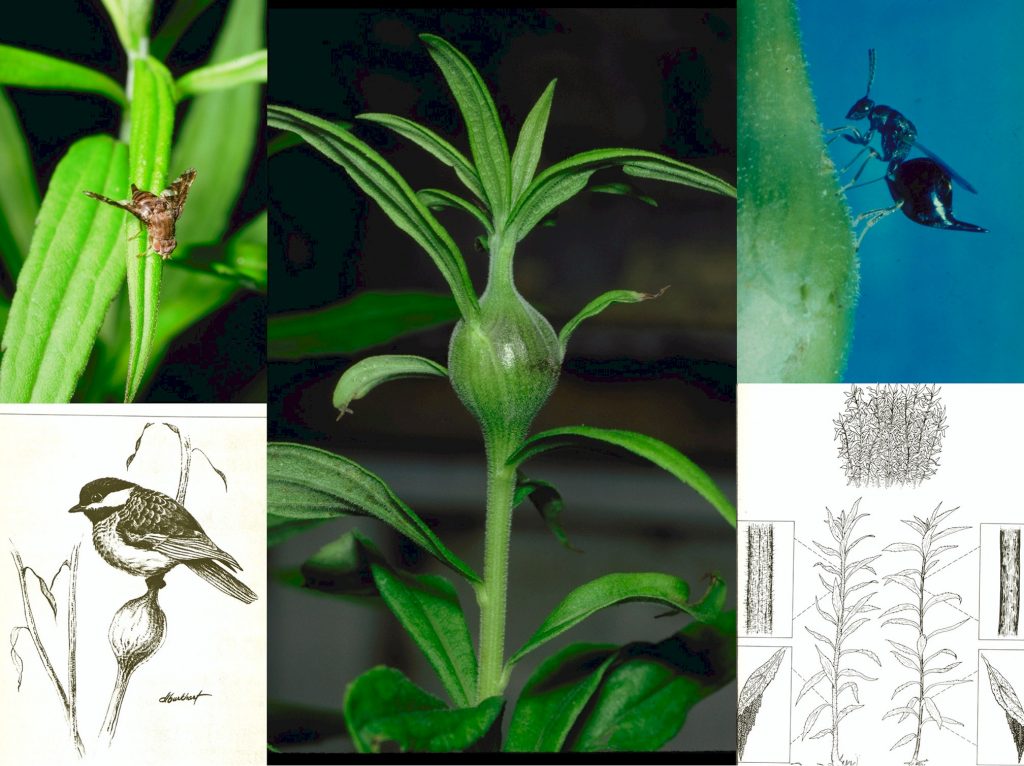
around how the stem gall fly (Eurosta solidaginis)
has evolved host races which utilize different species of Solidago.
One common misconception about goldenrods is
that they are a common cause of hay fever. This is not the case.
Goldenrod is an insect-pollinated plant that produces very large and sticky
pollen grains. Which is all the better to make sure insects come to feed
on the pollen and that some gets stuck to the insect's body. This ensures
that some of the pollen gets carried to other goldenrods, allowing cross-pollination.
Because goldenrod pollen is so large, it doesn't get carried very far on the
wind. A more likely villain for late-summer allergies is ragweed, which produces
large amounts of small wind-born pollen. The photo at the left shows a
typical old field in central Pennsylvania during early September. The
goldenrods here are mostly S. altissima, though other species are present.

If you see a goldenrod with a ball gall in central Pennsylvania,
it is almost certainly S. altissima (although we have found a very few
ball galls on S. canadensis). As you travel north into New England
you will find that the ball galls are also common on S. gigantea.
One of the primary areas of research in the Abrahamson laboratory has been to
determine why and how this host shift has occurred. Because the gall fly
(Eurosta solidaginis) mates on its host plant, host shifts can produce
a behavioral isolation between two populations of gall flies. This isolation
is very important because it may lead to sympatric speciation (speciation without
geographic isolation). If this is true, we are seeing the early stages of
speciation when we study host-race formation in gall flies.
When goldenrods bloom in late summer they provide a huge bonanza of food (nectar
and pollen) mainly for insects like the soldier beetle to the left.
|
|
|
|
|
|
|
|
|
|