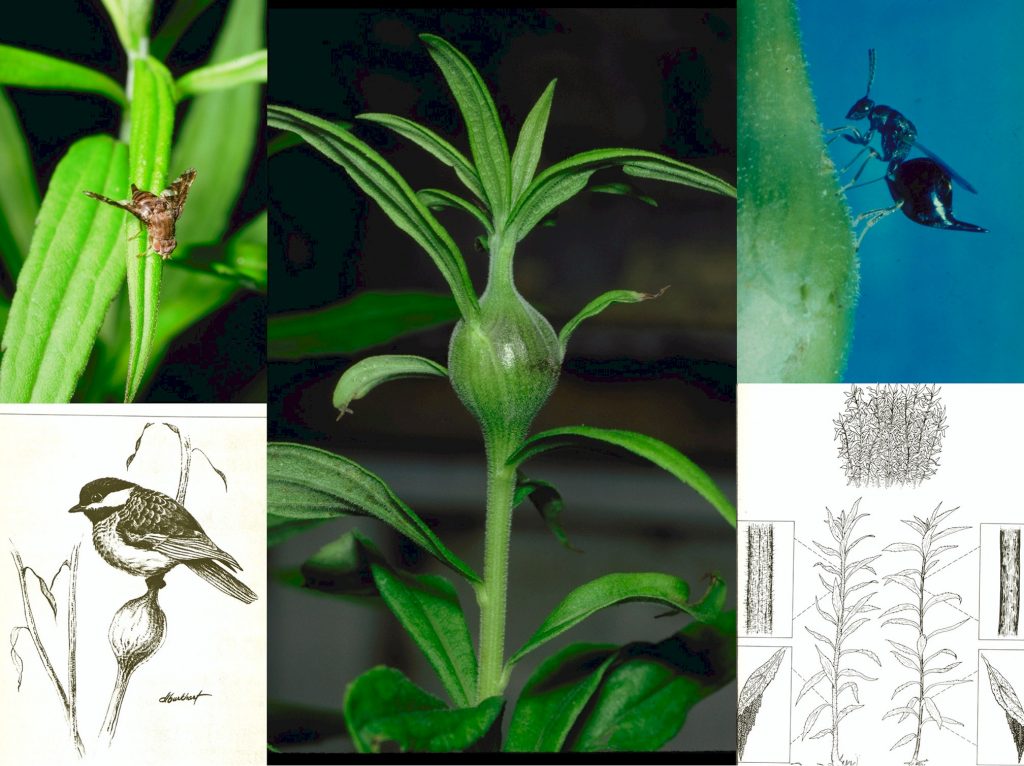
Eurytoma gigantea is a parasitoid wasp of the
gall fly (Eurosta solidaginis). It uses a long ovipositor to pierce the
gall and lay its egg in the fly's chamber. E. gigantea is arrhenotokous
(females emerge from fertilized eggs males from unfertilized eggs). The
success of attack is dependent on the thickness of the gall wall and on the
parasitoid's ovipositor length. E. gigantea's
attack season extends from the end of June until August (although hardening
of the gall wall may end attack by late July). Once hatching takes place,
the wasp larva quickly eats the Eurosta larva and continues to feed on
gall tissue until pupation. E. gigantea may use visual host cues when
searching for galls and only probe with its ovipositor on gall surfaces.
Interestingly, there is a bimodal emergence of E. gigantea wasps.
While about 90% of the wasp larva overwinter in the gall, the other 10% emerge
in late summer. Researchers have been unable to find an alternate host
for the wasp. Even if the late emergers overwinter as adults (outside the gall),
they do not attack new galls any earlier the next summer. The fate of
these early emergers is unknown.
The above sequence of photographs illustrates the courtship behavior of Eurytoma
gigantea. Photo 1 shows a small male (lower right of photo) approaching
a prospective mate. He's in no danger of being eaten like a male spider
or praying mantis, as adult Eurytoma feed on nectar from flowers. However,
the female is more than three times his size! Photo 2 shows the male jumping
onto the female's back. In Photos 3, 4, and 5 the male is riding on the
female's back while "bopping" her antenna with his own. This is apparently
some sort of courtship behavior. In the final photo (No. 6) the male is
trying to climb back over the female's wings to the tip of her abdomen, probably
to attempt copulation. The female has begun to insert her ovipositor into
the gall and probably not interested in mating. A moment later the male
fell off her wings and began searching for another mate.
A
second species of parasitoid wasp, Eurytoma obtusiventris, also uses
Eurosta as its exclusive host. Eurytoma obtusiventris is thelytokous
(parthenogenic females, no males) and oviposits into the host egg or larva while
the host is still in the goldenrod bud. The E. obtusiventris larva
remains quiescent inside the host larva until autumn. In autumn, the parasitoid
induces early pupation in the Eurosta larva and begins its own development.
The E. obtusiventris larva overwinters in the usurped gall and then emerges
in the early spring, in time to attack newly deposited Eurosta eggs and
larvae.
Here an adult Mordellistena beetle
is shown feeding on goldenrod pollen. Normally, Mordellistena would
not be seen feeding on goldenrod pollen, because the adult beetles are active
in late spring to late-summer.
|
|
|
|
|
|
| Solidago and Eurosta Links |
|
|